



Beyond the Grip: Strength for Table Tennis Mastery
The satisfying 'thwack' of a well-placed ball, the lightning-fast reflexes, the subtle dance across the table - these are the hallmarks of a skilled table tennis player. For many years, my own journey in sports has been deeply intertwined with the rhythm of life, finding equilibrium in movement and mindfulness. As I've navigated the decades, a consistent truth has emerged: true mastery in any sport, including table tennis, extends far beyond the simple mechanics of the grip. It's in the quiet preparation, the unseen strength forged off the court, that the magic truly happens. In recent times, I've observed a growing appreciation for what the online world terms "functional strength for racket sports" and a commendable surge in interest for "injury prevention for table tennis." These trends resonate deeply with my own experiences, reinforcing the profound connection between a resilient body and a dynamic game.
Many enthusiasts believe that more time on the table, or perhaps just mastering the perfect forehand spin, is the sole path to improvement. While dedication to practice is undeniably crucial, this viewpoint often overlooks a fundamental truth: the body is the instrument. Like a finely tuned violin, it requires careful maintenance and strengthening to produce its most exquisite music. The intensity of modern table tennis, with its rapid changes in direction and explosive strokes, demands more than just hand-eye coordination. It requires a robust foundation of physical capability. Today, I want to share how strategic strength training, approached with a veteran's perspective on lifelong fitness, can profoundly transform your table tennis game, pushing you beyond your current limits and safeguarding your passion for years to come.
Debunking the Myths: Strength Isn't Just for Bodybuilders
Before we delve into the practicalities, let's address some common misconceptions that might hold you back from embracing strength training for table tennis. The image of a hulking bodybuilder, grunting under heavy barbells, often dominates the perception of strength. However, this couldn't be further from the reality for athletes in precision sports like table tennis.
Myth 1: Strength Training Makes You Bulky and Slow
This is perhaps the most pervasive myth. The truth is, with the right approach - focusing on compound movements, controlled repetitions, and adequate rest - strength training builds lean muscle and enhances neuromuscular efficiency. For table tennis, this translates to quicker reactions and more powerful, yet controlled, movements, not sluggishness. The aim isn't to add mass for its own sake, but to increase the force your muscles can generate and the speed at which they can contract.
Myth 2: It's Only About Arm Strength
While arm and wrist strength are important for stroke execution, they are only one piece of a much larger puzzle. Table tennis is a full-body sport. Explosive power originates from the legs and core, and is transferred through the torso. A strong posterior chain (glutes, hamstrings, back) and a stable core are foundational for generating potent strokes and maintaining balance during rapid footwork. Neglecting these areas is like trying to power a grand piano with only one finger.
Myth 3: Strength Training is Too Risky for Injury
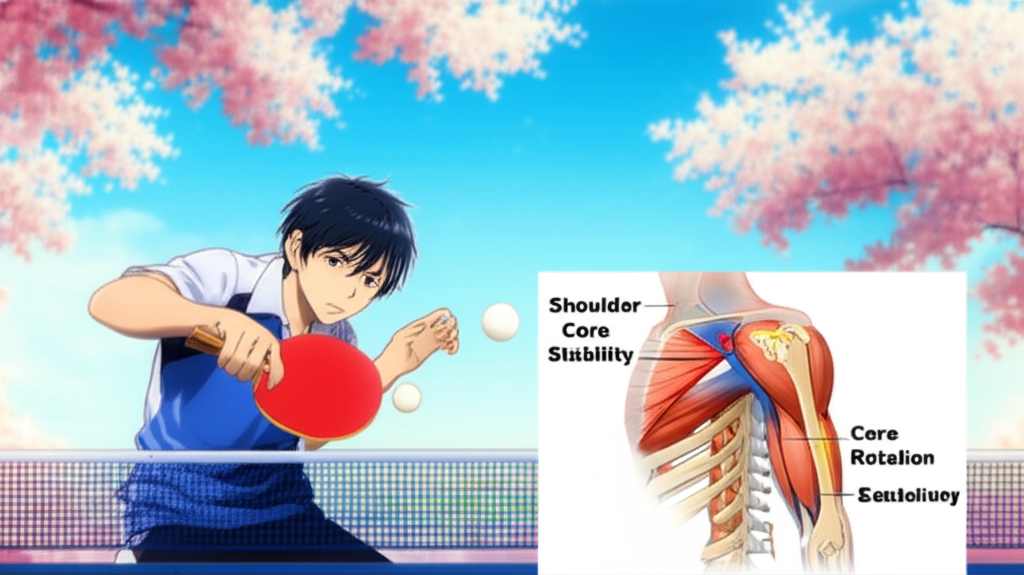
When performed with proper form and progressive overload, strength training is actually a powerful tool for injury prevention. It strengthens the muscles, tendons, and ligaments that support your joints, making them more resilient to the stresses of sport. In fact, unbalanced muscle development or weakness in supporting structures is often a far greater contributor to injuries. This is precisely why focusing on specific areas like shoulder stability is paramount.
The Pillars of Table Tennis Strength: A Phased Approach
Our goal is not to transform into powerlifters, but to cultivate a resilient, explosive, and precise athlete. I advocate a phased approach, beginning with foundational strength and gradually introducing more dynamic movements. This ensures we build a solid base, progressively challenging the body to adapt and grow stronger.
Phase 1: Building the Foundation (Weeks 1-4)
This phase is about mastering fundamental movement patterns and activating key muscle groups. Focus on controlled movements and perfect form. Equipment can be minimal, focusing on bodyweight and resistance bands.
Core Strength and Stability
A strong core is the nexus of power transfer in table tennis. Think of it as the engine of your body.
- Plank variations: Standard, side planks. Hold for 30-60 seconds.
- Bird-Dog: Improves core stability and balance. 10-15 reps per side.
- Glute Bridges: Activates glutes and lower back, crucial for hip drive. 15-20 reps.
Lower Body Power
Explosive footwork starts from the ground up.
- Bodyweight Squats: Focus on depth and control. 15-20 reps.
- Lunges (forward and reverse): Enhances balance and unilateral strength. 10-12 reps per leg.
- Calf Raises: Essential for quick directional changes. 20-25 reps.
Phase 2: Developing Rotational Power and Shoulder Stability (Weeks 5-8)
With a stable base, we now introduce movements that mimic the rotational demands of table tennis strokes and bolster shoulder health.
Rotational Power
The ability to generate force through rotation is key to powerful forehands and backhands.
- Medicine Ball Rotational Throws (against a wall): 10-15 reps per side. Start with a lighter ball. This exercise directly translates to the whipping motion of a forehand or the body rotation in a powerful backhand.
- Russian Twists (with or without weight): 15-20 reps per side. Focus on controlled rotation from the core.
- Band Rotations (seated or standing): 12-15 reps per side. Mimics the torso twist in strokes.
Shoulder Stability and Strength
Protecting your shoulder is paramount for longevity and consistent stroke execution.
- Band Pull-Aparts: Targets the rear deltoids and upper back, crucial for shoulder health. 15-20 reps.
- External/Internal Rotations (with resistance band): Important for rotator cuff strength. 15-20 reps per direction.
- Scapular Push-ups: Improves shoulder blade control. 10-15 reps.
Phase 3: Explosive Movements and Endurance (Weeks 9-12)
This phase integrates power and speed, preparing you for the demands of match play.
Explosive Footwork Drills
Translate strength into rapid court coverage.
- Jump Squats: 10-12 reps. Focus on soft landings.
- Lateral Bounds: 8-10 reps per side. Enhances side-to-side agility.
- Box Jumps (low height): 8-10 reps. Develops explosive vertical power.
Rotational Power Integration
Combine core strength with dynamic movement.
- Medicine Ball Slams: 10-12 reps. Engages the entire body in a powerful, downward motion that mirrors powerful strokes.
- Walking Lunges with a Twist: 10-12 reps per leg. Combines lower body strength with rotational core engagement.
The Direct Translation to the Table
The exercises described are not arbitrary. They are chosen for their ability to directly impact your table tennis performance. For instance, the medicine ball rotational throw directly mimics the kinetic chain that generates power in a forehand loop. A stronger core means more efficient energy transfer from your legs to your arm, resulting in a faster, heavier ball. Improved shoulder stability means you can swing with greater confidence and consistency, reducing the risk of injury and enhancing stroke variety.
I recall a particularly frustrating period about fifteen years into my journey. My forehand loop, once a formidable weapon, felt inconsistent, lacking its usual punch. I attributed it to age, to a fading of reflexes. A wise coach, seeing my struggle, suggested a dedicated program of rotational core strengthening and shoulder prehabilitation. Skeptical but willing, I incorporated exercises like medicine ball rotations and band pull-aparts. Within weeks, I felt a remarkable difference. The power returned, not just in my arm, but from my entire body. It was a profound lesson: true strength for sport is about integrated, functional movement, not just brute force.
Furthermore, enhanced muscular endurance from strength training means you can maintain your peak performance throughout longer matches. No more fatigue-induced errors in the crucial third game!
Strength Training vs. Bulk Building: A Crucial Distinction
It's vital to reiterate: the goal is not hypertrophy (muscle growth leading to bulk). For table tennis, we focus on neural adaptations and muscular endurance, often through higher repetitions (12-20) with moderate resistance, or explosive movements with bodyweight. This builds efficient, responsive muscles. This approach is also far more sustainable for lifelong fitness, aligning with my own philosophy of staying active and healthy well into one's later years.
| Exercise Focus | Table Tennis Benefit | Example Exercise |
|---|---|---|
| Core Stability | Power transfer, balance, injury prevention | Plank |
| Rotational Power | Stroke velocity, shot variation | Medicine Ball Rotational Throws |
| Shoulder Stability | Stroke consistency, injury prevention | Band Pull-Aparts |
| Explosive Footwork | Court coverage, agility, reaction time | Jump Squats |
A Path to Precision, Endurance, and Lifelong Wellness
The search trends for "functional strength for racket sports" and "injury prevention for table tennis" highlight a growing understanding that a holistic approach is key. Strength training is not merely a means to hit harder; it is a pathway to greater control, enhanced endurance, and most importantly, a sustainable and enjoyable experience with the sport for the long haul.
By building a resilient body, you reduce the aches and pains that can deter continued participation. You gain the confidence to push your boundaries on the court, knowing your body can support your ambitions. This mindful integration of off-court training into your table tennis regimen is a testament to a philosophy of lifelong fitness, where the joy of sport is preserved and amplified across the years.
"True strength in table tennis isn't just about the power behind the swing, but the resilience of the body that enables consistent execution and enduring passion. It's a quiet investment that yields the loudest victories on the court and the deepest satisfaction in life."
As you consider your next steps, remember that progress is rarely linear. Embrace the journey, listen to your body, and celebrate each small victory. The table tennis ball might be small, but the potential for growth, powered by intelligent strength, is immense.
Are you ready to move beyond the grip and unlock your table tennis potential? Start integrating these principles today. Your future, more powerful, more resilient, and more joyful self will thank you.